Discover our latest prints in our art & decor collection. Shop now
Malpine

← back to homepage
next story →
Malpine and the Raven's Covenant: A night run for the River Wood
Total reading time:
2–3 minutes
Written by:
Justin Morissette
The path
What the river forgets,
the wood remembers.
What the wood reveals, only the patient may hear.
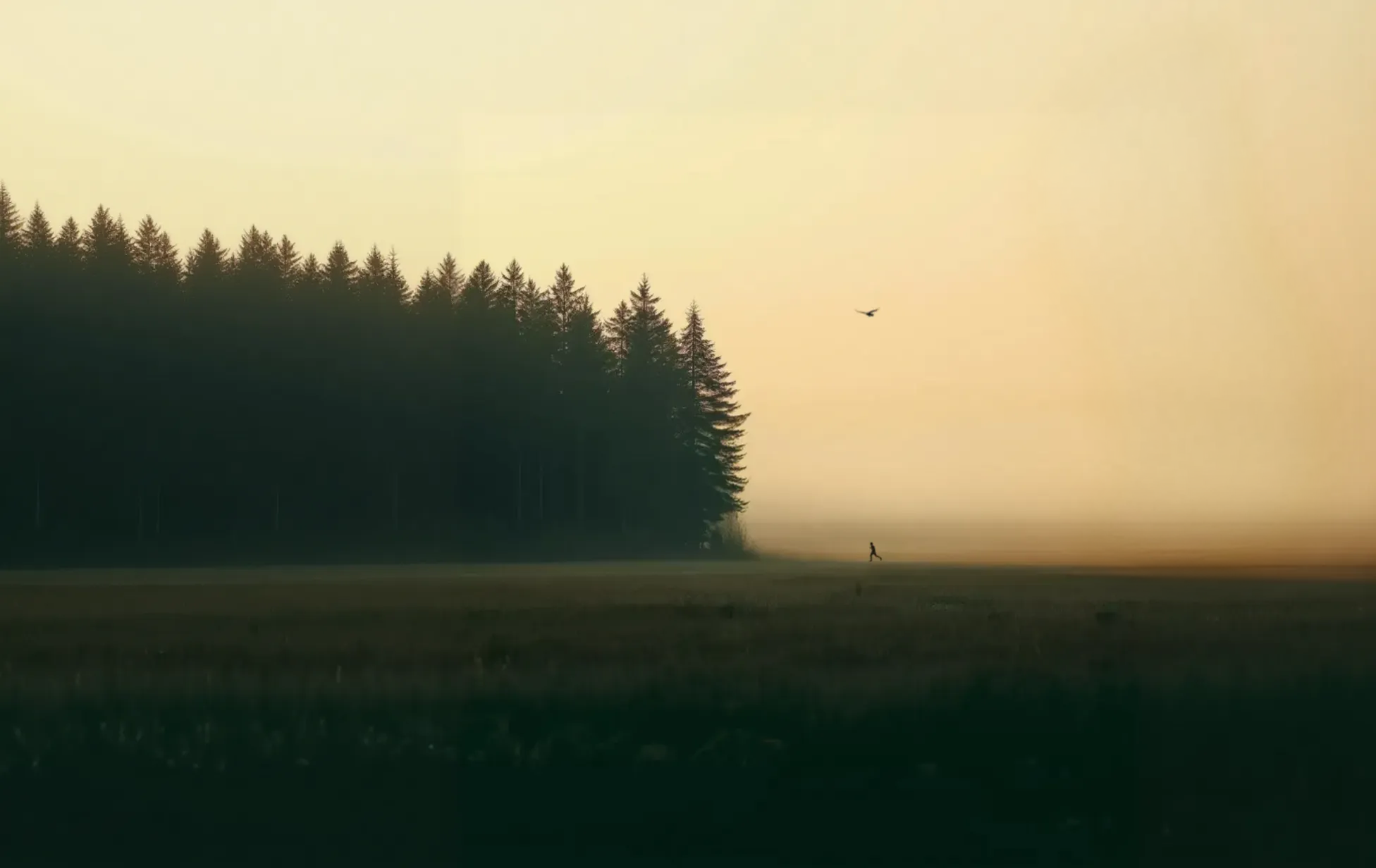
What the river forgets, the wood remembers. What the wood reveals, only the patient can hear it. At this suspended hour where darkness retreats without surrendering, I stand at the edge of the northern forests of St-Prosper, Quebec, Canada. The mist rises from a ground that bears the ages of the past in memory. A crow unfolds before me, not having come, simply being there. As if the forest had exhaled it from a breath older than dawn itself. Neither summoned, nor tamed, nor even awaited. Its shadow glides through the mist and cuts through the dark conifers, tracing a path where no trail exists. It guides me, with the beat of its broad black wings, some feathers stripped away. Through its resonant grave call, it tells me: I see you. I am here. Come. Follow me. This day, this forest, this passage to what I could not reach without its consent.
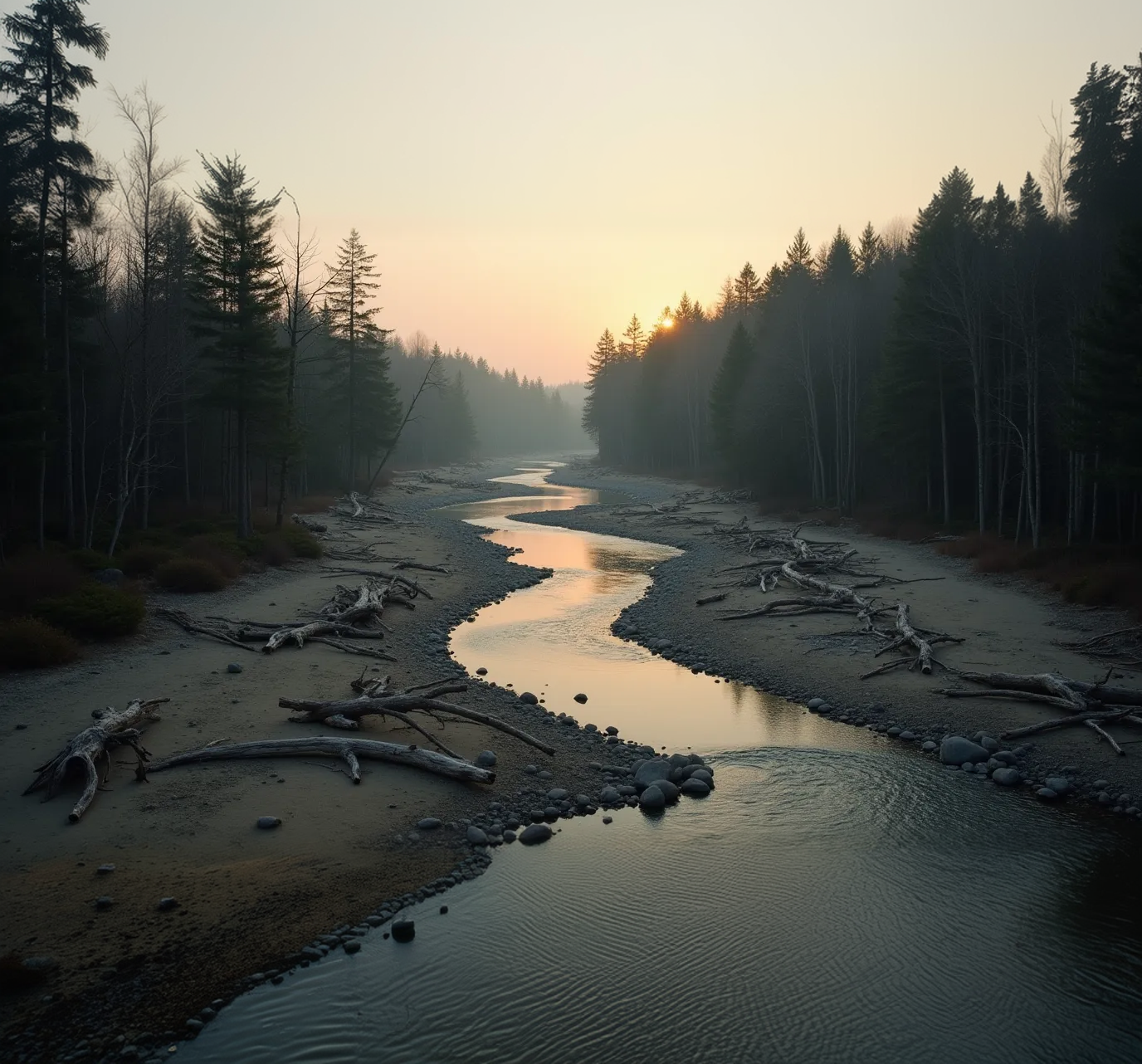
The riverbed winds through the valley like a glacial scar, twisted by forces that do not hurry, that count in centuries what we measure in seconds. The ice has risen here with tectonic patience, tearing the entire forest from its roots, laying down its dead: trunks, branches, bark, and gnarled roots like so many offerings rejected by eternity. I advance along this path that is not a path, at the quick pace of a hunter who knows the forest closes its doors.
The crow hovers above, an ancient guardian, watching over the threshold between day and night where no name yet resonates. Its flight seeks neither escape nor prey. It descends, slicing the air with its shadow, and sends me this message: Nothing in this forest wishes you harm. No blood will flow, neither mine nor yours. Fear is the tribute paid by indecision; pay it, and move on. It does not promise safety, it promises clarity.
There, in the braided currents where the river speaks with many voices, the wood waits. Not driftwood, this wreck of failed journeys, but wood still negotiating with its element. Far from salt. Far from the easy absolution of the sea. These pieces have been aged by vertical water, compressed by the weight of frozen months, cracked by the sun along the fault lines of their own biology, thawed, and condemned to freeze again. They bear tension like flesh bears trauma. Memory like lineage.
A deer emerges from the steam between the pines. Not startled. Not curious. Present in the way stones are present. Its antlers bear the same architecture as the branches above. We remain separated by the grammar of species, yet united by the syntax of attention. It breathes. I breathe. The exchange requires no movement. When it leaves, it does not leap nor flee. It simply decides to be elsewhere, and the forest accommodates this decision. I remain, changed by the quality of its gaze—dark, moist, ancient as the source of the river.
I gather until the light fades into darkness. Arms heavy with my bags filled with wood. Steps quickening with the knowledge that the hospitality of the forest has its terms. Night does not fall here; it rises from the ground, from the spaces between trees, claiming its jurisdiction slowly, then all at once. I carry what has been given to me. The burden is physical. The lightness is not.
The sun has set, and the moon hides. The entire forest sleeps in deep darkness, and I cannot turn on a lamp, for fear of waking it.
In the shadow, I move quickly, in rhythm with my breath, which becomes rapid yet deep, at the limits of voluntary asphyxiation and trance. Not fear grips me. Not the hunt drives me. But because I am full of the present moment, charged with a direction and a protection that are unseen, felt only in the blood, in the bristling of hairs, in that animal certainty that the body knows before the mind approves it. The crow has not left me, even when I could no longer see it. In the complete night where each step became an act of faith, I still felt the beat of its wings like a pulse in the black air, this ancient rhythm that precedes fear and surpasses it. I had loaded my bags to the painful curve of my shoulders, these pieces of river still moist with their history, and the forest had closed behind me without a sound, like a mouth that has finished speaking. I had not seen time pass. The light had withdrawn so discreetly that I could not tell at what exact moment day had yielded its place, only that suddenly, it was night, and that night possessed a particular density, an almost maternal presence in its refusal to let me see. Yet I moved forward, well, adapted, present, these three words becoming a mantra against the rising urgency. The wood thudded against my hips with each stride, a tangible reminder of my mission accomplished, of this silent pact sealed with the bird and the water. And when at last the lights of the workshop pierced the darkness, when the threshold closed behind me still trembling from the effort, I knew something had changed. I returned safe and sound, yes, but not unscathed. The forest had marked me with its invisible imprint, as it marks the wood it shapes. The crow had led me beyond what I had come to seek, to that border where the hunter becomes a witness, where fear transforms into attention, where the time forgotten in the quest recalls itself to you in the return, more precious than the finding itself.
The crow thinks aloud with a low coo: That one might traverse the forest without becoming predator or prey. Fear, that familiar contraction of the heart, dissolves when intention becomes transparent, when the self reduces to its essential signal, neither threat nor invitation, simply to advance. Above, the crow traces my return. I no longer see it. I feel the displacement of air, the tiny change in pressure of its passage.
The forest gives. I receive. This is not a transaction. It is the oldest economy, prior to language, prior to the human need to name what cannot be possessed.
The FRUIT
Thus the wood speaks:
I was arms,
I was root,
I was network and response,
I knew water before
water had its name,
I knew Fire before
fire had its name.
Take me—not to possess me,
But to continue what I have not finished:
The slow conquest of sky by patience.
The workshop receives me like a closing mouth. The threshold is sensory: rising temperature, falling humidity, the particular silence of enclosed space after the forest's infinite acoustics. Here, ritual becomes tactile sacrament.
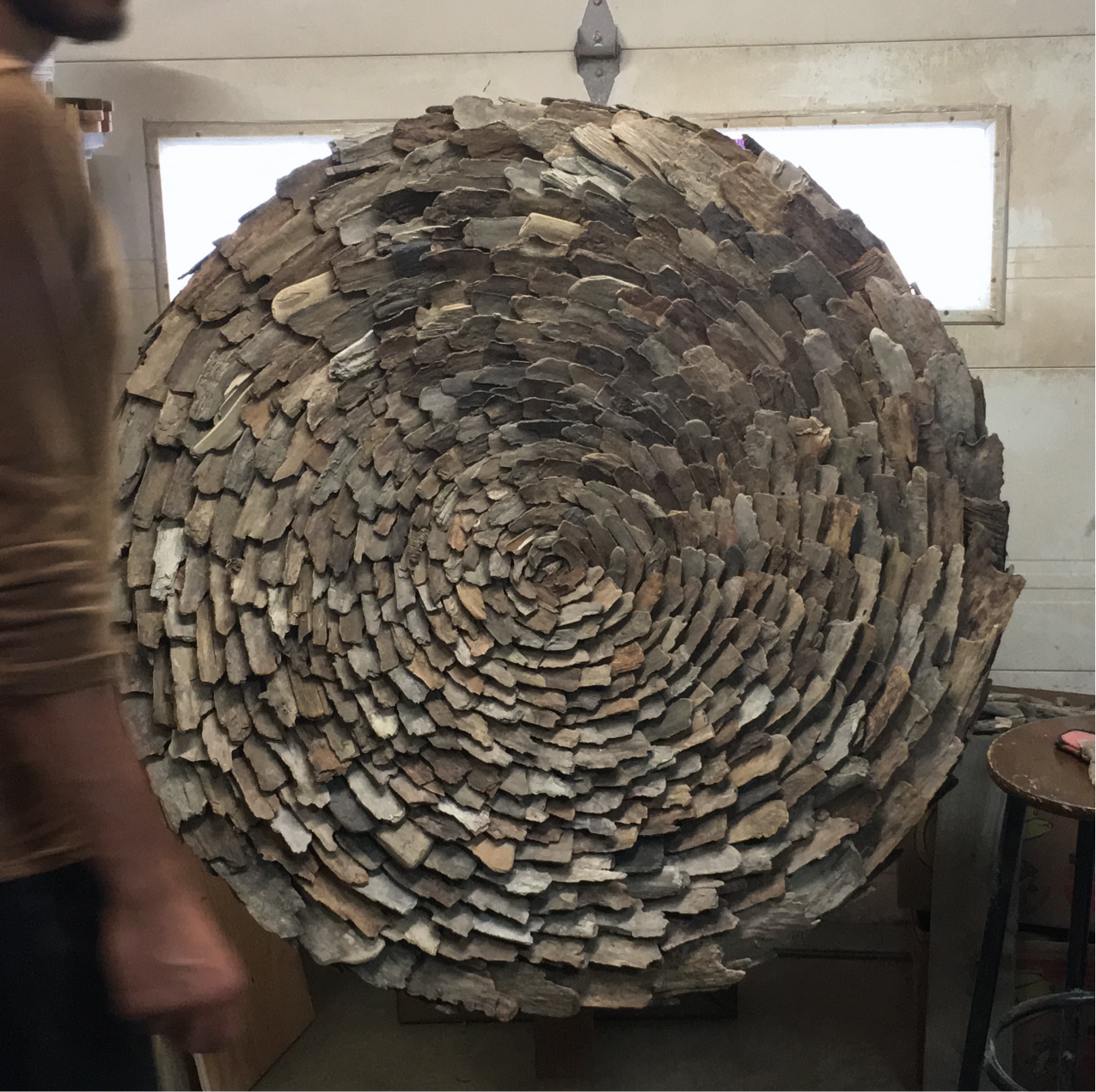
I brush the wood by hand. Slowly. The grain speaks in Braille—ridges, sudden silences, the raised scars of branch births. Bark yields at angles, not to force, but to persuasion. Heat is applied with the precision of last rites—not to consume, but to sanctify. Cleanse. Stabilize. Cellular memory, that liquid history of drought and deluge, is sealed into stillness. The wood dies its second death. The object begins its first life. Transformation is invisible to the hurried eye. Visible to the one who waits.
In my hand now: White oak. Quercus alba. The most uncompromising density of the boreal forest, silica-laden, heavy as silence after certain questions. It grew where wind carved slowly, where drought and flood succeeded each other like opposing liturgies, each leaving its mark in the grain's secret scripture. In its pores: iron, manganese, the dissolved memory of specific watersheds, specific stones. Heat reveals them unpredictably—landscapes emerging without design, darkening like old blood, like soil after rain. White oak grants no pardon to hesitation. It demands the hand's full presence. Each cut becomes covenant, each shaving a small faith kept.
The drawknife is my primary instrument. Curved like a question that has forgotten its answer. Handles perpendicular to the edge, forcing the body into relationship—pulling rather than pushing, receiving rather than taking. It removes material only where the grain consents. It cannot lie. It reveals what the river prepared and time concealed.
Tonight, the river wood dries on the workbench. Tomorrow, it will become an object, a shape, a utility. But tonight, I hold close the memory of the darkness traversed, of the wing that still traces its wake in my mind, of that primal certainty I touched with my fingertips when walking became surviving, and surviving became dancing. A race I will run again tomorrow, and every day that follows, as long as the river forgets and the wood remembers.
Wood is not matter. It is active memory, consciousness frozen in fiber. Trees communicate through mycelial networks beneath the soil—white filaments weaving darkness into a living web—exchanging nutrients and chemical warnings in transactions older than human economy, more silent than our prayers. A subterranean cognition. Natural intelligence: that which does not reason but knows, does not calculate but forewarns, does not possess but gives.
They record: drought in the spacing of rings—years of fear written in millimeters; fire in resin scars—wounds sealed in defensive amber; abundance in the confidence of density—flesh swollen with certainty. When I hold river wood, I hold time itself. These fragments I sand and heat were once long arms in the wind, antennae toward sky. Their cellular structures once pumped water against gravity with vegetal obstinacy, transformed light into sugar with precision no human chemistry equals. Xylem and phloem—its green blood, sap ascending and descending, the body's own vocabulary borrowed for vertical life, for the aspiration toward what escapes and nourishes at once.
Thus, in the regained clarity. The river has written, the tree has held on, and the crow has guided my steps when the night made every turn uncertain. Further on, the deer, wise and still, taught me that direction is not sought, it is felt. My hand reveals only what was already waiting for the light. And in the calm that follows the exploration, there remains something invisible, a soft and persistent trace, as if the forest still watched, silent and benevolent.


Join
the malpine club
for more stories, exclusive drops & content.

justin morissette 2026
site in progress
Discover our latest prints in our art & decor collection. Shop now
Malpine
← back to homepage
next story →
Malpine and the Raven's Covenant: A night run for the River Wood
Total reading time:
2–3 minutes
Written by:
Justin Morissette
The path
What the river forgets,
the wood remembers.
What the wood reveals, only the patient may hear.
What the river forgets, the wood remembers. What the wood reveals, only the patient can hear it.
At this suspended hour where darkness retreats without surrendering, I stand at the edge of the northern forests of St-Prosper, Quebec, Canada. The mist rises from a ground that bears the ages of the past in memory. A crow unfolds before me, not having come, simply being there. As if the forest had exhaled it from a breath older than dawn itself. Neither summoned, nor tamed, nor even awaited. Its shadow glides through the mist and cuts through the dark conifers, tracing a path where no trail exists. It guides me, with the beat of its broad black wings, some feathers stripped away. Through its resonant grave call, it tells me: I see you. I am here. Come. Follow me. This day, this forest, this passage to what I could not reach without its consent.
The riverbed winds through the valley like a glacial scar, twisted by forces that do not hurry, that count in centuries what we measure in seconds. The ice has risen here with tectonic patience, tearing the entire forest from its roots, laying down its dead: trunks, branches, bark, and gnarled roots like so many offerings rejected by eternity. I advance along this path that is not a path, at the quick pace of a hunter who knows the forest closes its doors.
The crow hovers above, an ancient guardian, watching over the threshold between day and night where no name yet resonates. Its flight seeks neither escape nor prey. It descends, slicing the air with its shadow, and sends me this message: Nothing in this forest wishes you harm. No blood will flow, neither mine nor yours. Fear is the tribute paid by indecision; pay it, and move on. It does not promise safety, it promises clarity.
There, in the braided currents where the river speaks with many voices, the wood waits. Not driftwood, this wreck of failed journeys, but wood still negotiating with its element. Far from salt. Far from the easy absolution of the sea. These pieces have been aged by vertical water, compressed by the weight of frozen months, cracked by the sun along the fault lines of their own biology, thawed, and condemned to freeze again. They bear tension like flesh bears trauma. Memory like lineage.
A deer emerges from the steam between the pines. Not startled. Not curious. Present in the way stones are present. Its antlers bear the same architecture as the branches above. We remain separated by the grammar of species, yet united by the syntax of attention. It breathes. I breathe. The exchange requires no movement. When it leaves, it does not leap nor flee. It simply decides to be elsewhere, and the forest accommodates this decision. I remain, changed by the quality of its gaze—dark, moist, ancient as the source of the river.
I gather until the light fades into darkness. Arms heavy with my bags filled with wood. Steps quickening with the knowledge that the hospitality of the forest has its terms. Night does not fall here; it rises from the ground, from the spaces between trees, claiming its jurisdiction slowly, then all at once. I carry what has been given to me. The burden is physical. The lightness is not.
The sun has set, and the moon hides. The entire forest sleeps in deep darkness, and I cannot turn on a lamp, for fear of waking it.
In the shadow, I move quickly, in rhythm with my breath, which becomes rapid yet deep, at the limits of voluntary asphyxiation and trance. Not fear grips me. Not the hunt drives me. But because I am full of the present moment, charged with a direction and a protection that are unseen, felt only in the blood, in the bristling of hairs, in that animal certainty that the body knows before the mind approves it. The crow has not left me, even when I could no longer see it. In the complete night where each step became an act of faith, I still felt the beat of its wings like a pulse in the black air, this ancient rhythm that precedes fear and surpasses it. I had loaded my bags to the painful curve of my shoulders, these pieces of river still moist with their history, and the forest had closed behind me without a sound, like a mouth that has finished speaking. I had not seen time pass. The light had withdrawn so discreetly that I could not tell at what exact moment day had yielded its place, only that suddenly, it was night, and that night possessed a particular density, an almost maternal presence in its refusal to let me see. Yet I moved forward, well, adapted, present, these three words becoming a mantra against the rising urgency. The wood thudded against my hips with each stride, a tangible reminder of my mission accomplished, of this silent pact sealed with the bird and the water. And when at last the lights of the workshop pierced the darkness, when the threshold closed behind me still trembling from the effort, I knew something had changed. I returned safe and sound, yes, but not unscathed. The forest had marked me with its invisible imprint, as it marks the wood it shapes. The crow had led me beyond what I had come to seek, to that border where the hunter becomes a witness, where fear transforms into attention, where the time forgotten in the quest recalls itself to you in the return, more precious than the finding itself.
The crow thinks aloud with a low coo: That one might traverse the forest without becoming predator or prey. Fear, that familiar contraction of the heart, dissolves when intention becomes transparent, when the self reduces to its essential signal, neither threat nor invitation, simply to advance. Above, the crow traces my return. I no longer see it. I feel the displacement of air, the tiny change in pressure of its passage.
The forest gives. I receive. This is not a transaction. It is the oldest economy, prior to language, prior to the human need to name what cannot be possessed.
The FRUIT
Thus the wood speaks:
I was arms,
I was root,
I was network and response,
I knew water before
water had its name,
I knew Fire before
fire had its name.
Take me—not to possess me,
But to continue what I have not finished:
The slow conquest of sky by patience.
The workshop receives me like a closing mouth. The threshold is sensory: rising temperature, falling humidity, the particular silence of enclosed space after the forest's infinite acoustics. Here, ritual becomes tactile sacrament.
I brush the wood by hand. Slowly. The grain speaks in Braille—ridges, sudden silences, the raised scars of branch births. Bark yields at angles, not to force, but to persuasion. Heat is applied with the precision of last rites—not to consume, but to sanctify. Cleanse. Stabilize. Cellular memory, that liquid history of drought and deluge, is sealed into stillness. The wood dies its second death. The object begins its first life. Transformation is invisible to the hurried eye. Visible to the one who waits.
In my hand now: White oak. Quercus alba. The most uncompromising density of the boreal forest, silica-laden, heavy as silence after certain questions. It grew where wind carved slowly, where drought and flood succeeded each other like opposing liturgies, each leaving its mark in the grain's secret scripture. In its pores: iron, manganese, the dissolved memory of specific watersheds, specific stones. Heat reveals them unpredictably—landscapes emerging without design, darkening like old blood, like soil after rain. White oak grants no pardon to hesitation. It demands the hand's full presence. Each cut becomes covenant, each shaving a small faith kept.
The drawknife is my primary instrument. Curved like a question that has forgotten its answer. Handles perpendicular to the edge, forcing the body into relationship—pulling rather than pushing, receiving rather than taking. It removes material only where the grain consents. It cannot lie. It reveals what the river prepared and time concealed.
Tonight, the river wood dries on the workbench. Tomorrow, it will become an object, a shape, a utility. But tonight, I hold close the memory of the darkness traversed, of the wing that still traces its wake in my mind, of that primal certainty I touched with my fingertips when walking became surviving, and surviving became dancing. A race I will run again tomorrow, and every day that follows, as long as the river forgets and the wood remembers.
Wood is not matter. It is active memory, consciousness frozen in fiber. Trees communicate through mycelial networks beneath the soil—white filaments weaving darkness into a living web—exchanging nutrients and chemical warnings in transactions older than human economy, more silent than our prayers. A subterranean cognition. Natural intelligence: that which does not reason but knows, does not calculate but forewarns, does not possess but gives.
They record: drought in the spacing of rings—years of fear written in millimeters; fire in resin scars—wounds sealed in defensive amber; abundance in the confidence of density—flesh swollen with certainty. When I hold river wood, I hold time itself. These fragments I sand and heat were once long arms in the wind, antennae toward sky. Their cellular structures once pumped water against gravity with vegetal obstinacy, transformed light into sugar with precision no human chemistry equals. Xylem and phloem—its green blood, sap ascending and descending, the body's own vocabulary borrowed for vertical life, for the aspiration toward what escapes and nourishes at once.
Thus, in the regained clarity. The river has written, the tree has held on, and the crow has guided my steps when the night made every turn uncertain. Further on, the deer, wise and still, taught me that direction is not sought, it is felt. My hand reveals only what was already waiting for the light. And in the calm that follows the exploration, there remains something invisible, a soft and persistent trace, as if the forest still watched, silent and benevolent.
Join the malpine club
for more stories, exclusive drops & content.

justin morissette 2026
site in progress
Discover our latest prints in our art & decor collection. Shop now
Malpine
← back to homepage
next story →
Malpine and the Raven's Covenant: A night run for the River Wood
Malpine and the Raven's Covenant: A night run for the River Wood
Total reading time:
2–3 minutes
Written by:
Justin Morissette
The path
What the river forgets,
the wood remembers.
What the wood reveals, only the patient may hear.
What the river forgets, the wood remembers. What the wood reveals, only the patient can hear it.
At this suspended hour where darkness retreats without surrendering, I stand at the edge of the northern forests of St-Prosper, Quebec, Canada. The mist rises from a ground that bears the ages of the past in memory. A crow unfolds before me, not having come, simply being there. As if the forest had exhaled it from a breath older than dawn itself. Neither summoned, nor tamed, nor even awaited. Its shadow glides through the mist and cuts through the dark conifers, tracing a path where no trail exists. It guides me, with the beat of its broad black wings, some feathers stripped away. Through its resonant grave call, it tells me: I see you. I am here. Come. Follow me. This day, this forest, this passage to what I could not reach without its consent.
The riverbed winds through the valley like a glacial scar, twisted by forces that do not hurry, that count in centuries what we measure in seconds. The ice has risen here with tectonic patience, tearing the entire forest from its roots, laying down its dead: trunks, branches, bark, and gnarled roots like so many offerings rejected by eternity. I advance along this path that is not a path, at the quick pace of a hunter who knows the forest closes its doors.
The crow hovers above, an ancient guardian, watching over the threshold between day and night where no name yet resonates. Its flight seeks neither escape nor prey. It descends, slicing the air with its shadow, and sends me this message: Nothing in this forest wishes you harm. No blood will flow, neither mine nor yours. Fear is the tribute paid by indecision; pay it, and move on. It does not promise safety, it promises clarity.
There, in the braided currents where the river speaks with many voices, the wood waits. Not driftwood, this wreck of failed journeys, but wood still negotiating with its element. Far from salt. Far from the easy absolution of the sea. These pieces have been aged by vertical water, compressed by the weight of frozen months, cracked by the sun along the fault lines of their own biology, thawed, and condemned to freeze again. They bear tension like flesh bears trauma. Memory like lineage.
A deer emerges from the steam between the pines. Not startled. Not curious. Present in the way stones are present. Its antlers bear the same architecture as the branches above. We remain separated by the grammar of species, yet united by the syntax of attention. It breathes. I breathe. The exchange requires no movement. When it leaves, it does not leap nor flee. It simply decides to be elsewhere, and the forest accommodates this decision. I remain, changed by the quality of its gaze—dark, moist, ancient as the source of the river.
I gather until the light fades into darkness. Arms heavy with my bags filled with wood. Steps quickening with the knowledge that the hospitality of the forest has its terms. Night does not fall here; it rises from the ground, from the spaces between trees, claiming its jurisdiction slowly, then all at once. I carry what has been given to me. The burden is physical. The lightness is not.
The sun has set, and the moon hides. The entire forest sleeps in deep darkness, and I cannot turn on a lamp, for fear of waking it.
In the shadow, I move quickly, in rhythm with my breath, which becomes rapid yet deep, at the limits of voluntary asphyxiation and trance. Not fear grips me. Not the hunt drives me. But because I am full of the present moment, charged with a direction and a protection that are unseen, felt only in the blood, in the bristling of hairs, in that animal certainty that the body knows before the mind approves it. The crow has not left me, even when I could no longer see it. In the complete night where each step became an act of faith, I still felt the beat of its wings like a pulse in the black air, this ancient rhythm that precedes fear and surpasses it. I had loaded my bags to the painful curve of my shoulders, these pieces of river still moist with their history, and the forest had closed behind me without a sound, like a mouth that has finished speaking. I had not seen time pass. The light had withdrawn so discreetly that I could not tell at what exact moment day had yielded its place, only that suddenly, it was night, and that night possessed a particular density, an almost maternal presence in its refusal to let me see. Yet I moved forward, well, adapted, present, these three words becoming a mantra against the rising urgency. The wood thudded against my hips with each stride, a tangible reminder of my mission accomplished, of this silent pact sealed with the bird and the water. And when at last the lights of the workshop pierced the darkness, when the threshold closed behind me still trembling from the effort, I knew something had changed. I returned safe and sound, yes, but not unscathed. The forest had marked me with its invisible imprint, as it marks the wood it shapes. The crow had led me beyond what I had come to seek, to that border where the hunter becomes a witness, where fear transforms into attention, where the time forgotten in the quest recalls itself to you in the return, more precious than the finding itself.
The crow thinks aloud with a low coo: That one might traverse the forest without becoming predator or prey. Fear, that familiar contraction of the heart, dissolves when intention becomes transparent, when the self reduces to its essential signal, neither threat nor invitation, simply to advance. Above, the crow traces my return. I no longer see it. I feel the displacement of air, the tiny change in pressure of its passage.
The forest gives. I receive. This is not a transaction. It is the oldest economy, prior to language, prior to the human need to name what cannot be possessed.
The FRUIT
Thus the wood speaks:
I was arms,
I was root,
I knew water before
water had its name,
I knew Fire before
fire had its name.
Take me—not to possess me,
But to continue what I have not finished:
The slow conquest of sky by patience.
The workshop receives me like a closing mouth. The threshold is sensory: rising temperature, falling humidity, the particular silence of enclosed space after the forest's infinite acoustics. Here, ritual becomes tactile sacrament.
I brush the wood by hand. Slowly. The grain speaks in Braille—ridges, sudden silences, the raised scars of branch births. Bark yields at angles, not to force, but to persuasion. Heat is applied with the precision of last rites—not to consume, but to sanctify. Cleanse. Stabilize. Cellular memory, that liquid history of drought and deluge, is sealed into stillness. The wood dies its second death. The object begins its first life. Transformation is invisible to the hurried eye. Visible to the one who waits.
In my hand now: White oak. Quercus alba. The most uncompromising density of the boreal forest, silica-laden, heavy as silence after certain questions. It grew where wind carved slowly, where drought and flood succeeded each other like opposing liturgies, each leaving its mark in the grain's secret scripture. In its pores: iron, manganese, the dissolved memory of specific watersheds, specific stones. Heat reveals them unpredictably—landscapes emerging without design, darkening like old blood, like soil after rain. White oak grants no pardon to hesitation. It demands the hand's full presence. Each cut becomes covenant, each shaving a small faith kept.
The drawknife is my primary instrument. Curved like a question that has forgotten its answer. Handles perpendicular to the edge, forcing the body into relationship—pulling rather than pushing, receiving rather than taking. It removes material only where the grain consents. It cannot lie. It reveals what the river prepared and time concealed.
Tonight, the river wood dries on the workbench. Tomorrow, it will become an object, a shape, a utility. But tonight, I hold close the memory of the darkness traversed, of the wing that still traces its wake in my mind, of that primal certainty I touched with my fingertips when walking became surviving, and surviving became dancing. A race I will run again tomorrow, and every day that follows, as long as the river forgets and the wood remembers.
Wood is not matter. It is active memory, consciousness frozen in fiber. Trees communicate through mycelial networks beneath the soil—white filaments weaving darkness into a living web—exchanging nutrients and chemical warnings in transactions older than human economy, more silent than our prayers. A subterranean cognition. Natural intelligence: that which does not reason but knows, does not calculate but forewarns, does not possess but gives.
They record: drought in the spacing of rings—years of fear written in millimeters; fire in resin scars—wounds sealed in defensive amber; abundance in the confidence of density—flesh swollen with certainty. When I hold river wood, I hold time itself. These fragments I sand and heat were once long arms in the wind, antennae toward sky. Their cellular structures once pumped water against gravity with vegetal obstinacy, transformed light into sugar with precision no human chemistry equals. Xylem and phloem—its green blood, sap ascending and descending, the body's own vocabulary borrowed for vertical life, for the aspiration toward what escapes and nourishes at once.
Thus, in the regained clarity. The river has written, the tree has held on, and the crow has guided my steps when the night made every turn uncertain. Further on, the deer, wise and still, taught me that direction is not sought, it is felt. My hand reveals only what was already waiting for the light. And in the calm that follows the exploration, there remains something invisible, a soft and persistent trace, as if the forest still watched, silent and benevolent.
Join the malpine club
for more stories, exclusive drops & content.

justin morissette 2026
site in progress